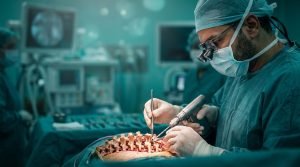
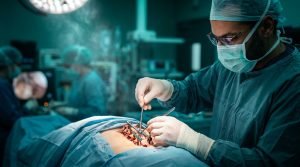
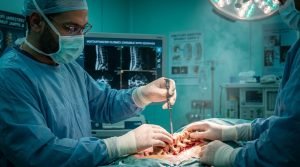
Pediatric Spine Surgery encompasses specialized treatments for early-onset scoliosis, congenital anomalies, and developmental tracking disorders in children. The core challenge is realigning the spine while completely protecting normal pulmonary and thoracic growth.
Clear, patient-friendly language explaining pediatric spine surgery. Google prioritizes E-E-A-T and YMYL. A clean list of warning signs that trigger search intent.
Early developmental spinal abnormalities noted in infants or young children.
Progressive rib-cage deformity limiting healthy thoracic expansion and lung volume.
Underlying syndromic or neuromuscular indicators paired with spinal tracking issues.
State-of-the-Art Corrective Procedures
Magnetically Controlled Growing Rods (MCGR)
Implanting dynamic growth rods that are safely lengthened non-invasively via an external magnetic controller in the clinic every few months.
Congenital Hemi-Vertebra Resection
Early precision removal of a single wedge-shaped, abnormally formed bone segment to let the remaining spine grow perfectly straight.
Real Transformations: Pediatric Spine Surgery Before & After Cases
How often do modern magnetically controlled growth rods require open surgical lengthening?
Never after the initial surgical placement. The subsequent lengthening workflows are executed completely non-invasively within minutes during a standard outpatient clinical review.
At what age is early-onset scoliosis surgery typically initiated?
Surgical tracking via growing systems is considered anytime a severe progressive curve emerges before age 10 that cannot be controlled with specialized casting or bracing.
Are childhood growing rods safe for regular diagnostic MRI scans?
Traditional rods had strict limitations, but modern MCGR setups use highly advanced titanium components compatible with specialized low-tesla imaging environments under strict specialist protocols.
Schedule a Private Consultation with Prof. Dr. Hazem