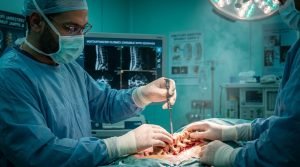
Advanced Scoliosis Correction: Precision 3D Spinal Realignment
Scoliosis involves a sophisticated three-dimensional curvature of the spine, predominantly diagnosed during adolescent growth spurts but also manifesting in adult populations due to asymmetric structural degeneration. Advanced structural diagnostics utilizing clinical Cobb angle profiling accurately map individual parameters to devise definitive orthopedic strategies.
Clear, patient-friendly language explaining scoliosis correction. Google prioritizes E-E-A-T and YMYL. A clean list of warning signs that trigger search intent.
Asymmetrical shoulder heights and unilateral rib prominence.
Visible lateral shifting of the entire torso relative to the pelvis.
Localized fatigue and muscular strain along the spinal concavity.
State-of-the-Art Corrective Procedures
Posterior Spinal Fusion
The stabilization of severe spinal curves using high-tensile titanium constructs to securely fuse affected motion segments into perfect 3D structural alignment.
Vertebral Body Tethering (VBT)
A specialized non-fusion alternative utilizing dynamic flexible cords to modulate growth, correcting curves while preserving structural mechanical flexibility.
Real Transformations: Scoliosis Correction Before & After Cases
BeforeAfter
"Finding Prof. Hazem changed my life."
- Sarah's Mom
Scoliosis Correction: Frequently Asked Questions
When does adolescent scoliosis strictly require corrective surgical intervention?
Surgical realignments are thoroughly indicated when a patient's primary curve progresses rapidly beyond 40 to 45 structural degrees, or when bracing options fail to control severe adolescent development.
What is the average long-term success and correction rate for modern scoliosis surgery?
Modern internal fixation systems routinely achieve an immediate 70% to 90% correction of the primary curve, radically restoring physical alignment, trunk balance, and self-esteem.
How long is the typical post-operative recovery timeline before a student can return to school?
Most patients walk within 24 to 48 hours post-op and are safely discharged within 4 to 5 days. A typical return to normal school environments takes approximately 3 to 4 weeks.
Schedule a Private Consultation with Prof. Dr. Hazem